St Peter & St Paul, Pettistree
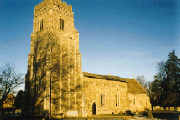 Pettistree is first recorded for valuation purposes in 1253. Until the
thirteenth century people attended Loudham church beside the Hall and this
remained in use until 1589. The first Pettistree church was built in the
thirteenth century and the base of the font and grisaille glass remains in the
present building. The first building was probably low and towerless. As the
wealth of the settlement grew Campsea Priory added Loudham and Pettistree to
its dependent parishes. A reconstruction was started in the late fourteenth
century. The fifteenth century tower, bells, brass and benches indicate an
increasingly flourishing community. During the Reformation many features were
defaced and there is a tradition that fine stained glass was removed, hidden
buried for safety and the whereabouts forgotten.
Pettistree is first recorded for valuation purposes in 1253. Until the
thirteenth century people attended Loudham church beside the Hall and this
remained in use until 1589. The first Pettistree church was built in the
thirteenth century and the base of the font and grisaille glass remains in the
present building. The first building was probably low and towerless. As the
wealth of the settlement grew Campsea Priory added Loudham and Pettistree to
its dependent parishes. A reconstruction was started in the late fourteenth
century. The fifteenth century tower, bells, brass and benches indicate an
increasingly flourishing community. During the Reformation many features were
defaced and there is a tradition that fine stained glass was removed, hidden
buried for safety and the whereabouts forgotten.
 By
1609 Loudham parishioners were attending Pettistree church. In the eighteenth
century further restoration took place. The roof was raised and seating
increased and Pettistree became an independent parish. The medieval benches,
pulpit and lectern were replaced by Mrs Brook of Pettistree Lodge in the
nineteenth century.
By
1609 Loudham parishioners were attending Pettistree church. In the eighteenth
century further restoration took place. The roof was raised and seating
increased and Pettistree became an independent parish. The medieval benches,
pulpit and lectern were replaced by Mrs Brook of Pettistree Lodge in the
nineteenth century.
As far as is known Pettistree has never had a Parish priest of its own and has been linked with either Bredfield or Wickham Market since around the late seventeenth century. In 1598 the Parish Register was transcribed by Rev. Leonard Staveley, Clerk to both Pettistree and Ufford, from the earlier version started in 1539.
In more recent times the tower was restored in 1979 and the bells restored in 1986, having been silent since World War Two.
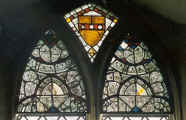 The medieval glass in the chancel was restored by
Surinder Warboys in 1991.
The medieval glass in the chancel was restored by
Surinder Warboys in 1991.
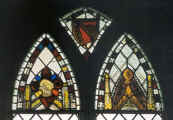 The
restored glass was dedicated at Harvest Festival in 1991.
The
restored glass was dedicated at Harvest Festival in 1991.
The Suffolk Record Office houses the 1598 Pettistree Parish Register:
'Surely one of the most attractive parish registers produced at any church, this exquisite penmanship is the work of Leonard Staveley, vicar, written "by his labour and sweat" on 24th June 1598. It is a transcript of the earliest register of the parish from 1539, and was continued by Staveley until December 1620, when he died. The text includes both patriotic salutations of Queen Elizabeth and expressions of piety; at the top of folio 26 we have the writer's own philosophy: "Lyfe is striefe, Love is a Solace".' Copyright © Suffolk County Council.
For further information and some more pictures please visit Simon's Suffolk Churches